THAT — The Analog Thing · Volume 7
THE Analog Thing — Volume 7 — Comparison & context
Where THAT sits on the spectrum from Heathkit tube toys to EAI floor consoles and what the modern market offers
7.1 About this Volume
This volume situates THE ANALOG THING (THAT) on the full spectrum of analog computing history and the current market. The goal is not advocacy but calibration: a senior engineer reaching for THAT deserves to know exactly what capabilities are gained, what are deliberately traded away, and how the machine compares with every plausible alternative — vintage and modern.
The element inventory used throughout is drawn from the v1.3 schematics (front and base PCBs, dated 03.2022) and confirmed against the First Steps v2 manual:
Table 1 — The element inventory used throughout is drawn from the v1.3 schematics (front and base PCBs, dated 03.2022) and confirmed against the First Steps v2 manual
| Block | Count | Notes |
|---|---|---|
| Integrators | 5 | INT1–INT5; each with 5 inputs (×1 ×1 ×1 ×10 ×10), IC jack, SLOW jack, 2 output jacks |
| Summers | 4 | SUM1–SUM4; each with 7 inputs (×1 ×1 ×1 ×1 ×10 ×10 ×10), FB jack, 2 output jacks |
| Inverters | 4 | INV1/2 and INV3/4 (paired on schematic pages) |
| Multipliers | 2 | MUL1/2; four-quadrant |
| Comparators | 2 | CMP1/2; output routes to > or < branch |
| Coefficient pots | 8 | COEFF1–8; panel-mounted single-turn |
| Resistor networks (XIR) | 2 | XIR1/2; extend summing junctions |
| Machine-unit jacks | — | ±1 reference rails distributed to each integrator group |
| Operating voltage | ±10 V | DC/DC converter from 5 V USB-C to ±12 V rail; machine unit is ±10 V |
Cross-references: hardware topology and open-hardware ethos are covered in Vol 1 and Vol 2; computing elements and patch-panel technique in Vol 3; scaling and ODE programming in Vol 4; worked programs in Vol 5; hybrid and multi-unit expansion in Vol 6.
7.2 THAT vs the Heathkit EC-1
7.2.1 Historical framing
The Heathkit EC-1 Educational Analog Computer (introduced c. 1959–1960, sold until c. 1971 at USD 199.95 kit or ~$400 assembled) represents the archetypal affordable educational analog computer of the vacuum-tube era. A complete treatment of the EC-1’s architecture, restoration, and programming appears in the companion deep-dive reference “the Heathkit EC-1 deep dive” in this library; only the comparison-relevant facts are recapitulated here.
7.2.2 Machine-unit voltage
This is the most immediately striking difference.
EC-1  ──────────────────────────────────────────  ±60 V
                                                   │
                   THAT  ────────────────  ±10 V   │
                                                   │
           Modern logic ──── 3.3 V / 5 V           │
The EC-1’s ±60 V range emerged from the tube-era requirement that operational amplifiers based on the 6U8 dual-triode/pentode achieve useful open-loop gain and output current headroom (±60 V at 0.7 mA per amplifier) at practical quiescent points. THAT achieves ±10 V machine units from a ±12 V rail generated internally by a DC/DC converter driven by a USB-C 5 V supply (the power-supply section on the base PCB is visible in the v1.3 base schematics). This means THAT’s outputs are directly compatible with standard audio interfaces, DSO probes rated for ±15 V, microcontroller ADCs with appropriate resistor dividers, and the 0–3.3 V HYBRID port (output-shifted internally) — none of which the EC-1 can drive without level-shifting hardware.
7.2.3 Technology generation
Table 2 — Technology generation
| Dimension | Heathkit EC-1 | THAT v1.3 |
|---|---|---|
| Active devices | 9 × 6U8 vacuum tubes (one per op-amp) | Precision solid-state op-amps (TL074H or equivalent, ~15 per computing block) |
| Supply voltage | +300 V regulated (electronically), −150 V (OA2 VR tube) | ±12 V from internal DC/DC; input 5 V USB-C |
| Machine unit | ±60 V | ±10 V |
| Power consumption | ~100 W (VAC mains, transformer + tube heaters) | <5 W (USB-C) |
| Warm-up drift | Minutes (tube stabilisation required) | Negligible (solid-state) |
| Noise floor | Higher (tube shot noise + thermal) | Lower (precision op-amps, ±10 µV offset typical) |
| Bandwidth (inverter) | −1 dB at 600 Hz | Adequate for REP/REPF mode use cases; op-amp unity-gain BW well into MHz |
| Physical mass | ~43 lbs (19.5 kg) | ~750 g (estimated from PCB assembly) |
| Footprint | 19¾” × 11½” front panel | ~A4 (210 × 297 mm equivalent) |
7.2.4 Computing-element inventory comparison
Table 3 — Computing-element inventory comparison
| Element type | EC-1 | THAT |
|---|---|---|
| Op-amps (uncommitted) | 9 (wired by plug-ins as integrators, summers, or inverters) | 0 — all committed to specific blocks |
| Dedicated integrators | Configurable (typically 4–6) | 5 (fixed) |
| Dedicated summers | Configurable | 4 (fixed) |
| Dedicated inverters | Configurable | 4 (fixed) |
| Multipliers | 0 (none on base unit) | 2 |
| Comparators | 0 (none on base unit) | 2 |
| Coefficient potentiometers | 5 panel-mounted | 8 panel-mounted |
| Repetitive operation | Built-in multivibrator, 0.1–15 cps | REP (0–10 s) and REPF (0–100 ms) modes |
| Daisy-chaining | Not supported | MASTER OUT / MINION IN (unlimited chain) |
| Hybrid interface | None | HYBRID port, 0–3.3 V shifted outputs |
Note — The EC-1’s uncommitted amplifiers give flexibility in how many integrators versus summers the operator configures, at the cost of requiring plug-in RC networks to be physically inserted. THAT’s committed architecture eliminates that step but fixes the ratio of computing elements.
7.2.5 Patch-panel interface
The EC-1 uses standard banana-binding-post construction (red/black posts, resistor/capacitor plug-in modules at 27 two-pin brown sockets). THAT uses 2 mm banana-plug patch cables with gold-plated through-holes in a thick FR4 front PCB — a novel socket design that eliminates the expensive gold-plated socket bodies while maintaining reliable spring contact. Input jacks are marked with circles, output jacks with triangles, and machine-unit jacks with split diamonds — a clear visual grammar absent from the EC-1’s colour-coded post field.
7.2.6 Availability and restoration burden
The EC-1 is a vintage-only machine: the Heath Company ceased production in 1971. Acquisition requires finding a working or restorable unit on the secondary market (typical prices USD 420–1,500 at time of writing), followed by capacitor reformation or replacement, tube testing, and often resistor restoral. THAT is in active production by anabrid GmbH (Berlin/Frankfurt, Germany) with ISO 9001 / ISO 14001 manufacturing (Neuschafer Elektronik, from batch 2.0 onward). By Newsletter #8 (June 2022) anabrid reported that THAT had already outsold the most prolific Telefunken and EAI desktop models in terms of total units.
7.2.7 Summary diagram — EC-1 vs THAT
                         EC-1                    THAT
                    ┌────────────┐          ┌────────────┐
  Technology        │  Tube/1959 │          │ Solid/2021 │
  Machine unit      │   ±60 V   │          │   ±10 V   │
  Power             │   100 W   │          │    <5 W   │
  Multipliers       │    None   │          │     2     │
  Comparators       │    None   │          │     2     │
  Hybrid I/O        │    None   │          │  3.3 V    │
  Daisy-chain       │    None   │          │Unlimited  │
  Availability      │  Vintage  │          │  In prod  │
                    └────────────┘          └────────────┘
7.2.8 When the EC-1 still makes sense
- Dedicated tube-era authenticity or museum demonstration
- Teaching the historical relationship between tube amplifier design and analog computing
- A restoration project as an end in itself (see the Heathkit EC-1 deep dive)
For any new educational or research program, THAT’s practical advantages are decisive.
7.3 THAT vs Classic Big Iron — EAI and Telefunken
7.3.1 The big-iron era
From roughly 1950 to the mid-1970s, professional analog and hybrid computing was dominated by large-format systems from a small number of manufacturers. The two most extensively documented in this library are:
- Electronic Associates, Inc. (EAI), Long Branch, NJ — produced the PACE series (TR-10, TR-20, TR-48), the 580/680 rack systems, and later the EAI-2000 and SIMSTAR; also the MiniAC educational desktop.
- Telefunken (later AEG-Telefunken), Germany — produced the RAT-700, RA-741, RA-742, RA-770, RA-800, and hybrid systems such as the HRS-860/900.
Both manufacturers also built systems in the 10–100 amplifier range occupying full equipment rooms.
7.3.2 Illustrative EAI comparison — PACE TR-10 / TR-20 desktop
The PACE TR-10 was a fully transistorised desk-top machine (specifications per the EAI procurement specification in this library):
Table 4 — The PACE TR-10 was a fully transistorised desk-top machine (specifications per the EAI procurement specification in this library)
| Parameter | EAI PACE TR-10 / TR-20 | THAT |
|---|---|---|
| Amplifiers | Up to 20 operational amplifiers (uncommitted) | 5 int + 4 sum + 4 inv = 13 committed |
| Reference voltage | ±10 V (±100 V on some configurations) | ±10 V |
| Potentiometers | Up to 24 precision 10-turn pots | 8 single-turn panel pots |
| Multipliers | Up to 9 quarter-square multipliers (plug-in) | 2 (built-in) |
| Function generators | Up to 18 diode FGs (plug-in) | None |
| Comparators | 1 (optional) | 2 |
| Overload indication | Per-amplifier OL lamp | OL LED (panel) |
| Bandwidth | 200 kHz (amplifier specification) | Adequate for educational REP/REPF operation |
| Physical size | 16” W × 23” H × 16” D (max 100 lbs) | ~A4, ~750 g |
| Power | Mains | USB-C 5 V |
| Era | 1964–1970s | 2021–present |
| Market price (new) | Thousands of 1960s USD | ~EUR 380 (see §5) |
| Availability | Vintage/surplus only | In production |
The key insight is that the TR-10/20’s uncommitted amplifier architecture gives it total flexibility at the cost of a much larger patch board, physically larger plug-in modules, a mains power supply, and a price that restricted it to well-funded laboratories and universities.
7.3.3 Illustrative Telefunken comparison — RA-741 / RA-742
The Telefunken transistorised desktop series spanned the RAT-700, RA-741, and RA-742. Documentation in this library (RA-741 Beschreibung, RA-742 Beschreibung and Informationsblatt, and the 2006 workshop slides “Telefunken RA741-RA742 — Workshop Analog Computing”) indicates a machine in a similar class to the EAI TR-20: 20–40 uncommitted operational amplifiers, precision servo or wire-wound multi-turn potentiometers, optional multiplier plug-ins, and an all-transistor ±10 V reference in later models.
The workshop slides note that the RA-742 was the primary teaching machine in German universities from the mid-1960s through the 1970s — the exact role THAT plays today. Key differences from THAT: the RA-742’s uncommitted amplifiers required the operator to physically configure RC plug-in modules to select integrator or summer function; THAT eliminates this step by committing all elements at design time. Multi-turn servo pots on the RA-742 gave higher coefficient-setting resolution than THAT’s single-turn panel pots — at the cost of a dedicated potentiometer-setting procedure requiring a precision DVM and a null meter.
The RA-770 and RA-800 series (Telefunken’s larger rack machines) scaled to 40+ amplifiers with built-in digital voltmeter readout, optional hybrid interfaces (DEX-102, DEX-802 digital add-on units), and precision servo multiplication. The HRS-860 and HRS-900 hybrid computing systems integrated an analog mainframe with a dedicated digital processor.
Table 5 — Illustrative Telefunken comparison — RA-741 / RA-742
| Parameter | Telefunken RA-742 | THAT v1.3 |
|---|---|---|
| Amplifiers | Multiple uncommitted (typ. 20) | 13 committed (5 int + 4 sum + 4 inv) |
| Pots | Multi-turn servo, high resolution | 8 single-turn panel, ~1% resolution |
| Machine unit | ±10 V | ±10 V |
| Multipliers | Optional plug-in | 2 built-in |
| Hybrid option | DEX-102 digital add-on | HYBRID port (0–3.3 V) |
| Power | Mains AC | USB-C 5 V |
| Era | 1966–1975 (production) | 2021–present |
| Availability | Vintage/surplus | In production |
The Telefunken RA-800 and EAI EAI-580 (circa 1966–1970) represent the upper tier of desk/rack precision systems: the EAI-580 operator’s reference handbook (in this library) documents an amplifier section with amplifier output selectable via a readout selector, a built-in digital voltmeter, and 40+ amplifier configurations — capabilities that THAT does not attempt to match.
7.3.4 Big-iron rack systems and hybrid complexes
Large EAI systems (EAI-580, EAI-680, EAI-2000) and Telefunken rack systems (HRS-860, HRS-900) represented the high end: 40–100+ amplifiers, servo multipliers or electronic multipliers, function generator modules, digital voltmeter readout, and eventually direct digital hybrid interfaces. These systems occupied entire rooms, required dedicated power distribution (often three-phase), environmental control, and specialised maintenance staff. They solved problems in aerospace simulation, reactor physics, and control-system design that required tens of simultaneous state variables and precision beyond the two-decimal-place capability typical of desktop machines.
The EAI HYDAC (Hybrid Digital Analog Computer, documented in this library under EAI_HYDAC Series 2000) paired an EAI PACE 231R analog mainframe with an IBM 7094-compatible digital processor. The Telefunken DEX-102 and DEX-802 (Digitalzusatz — “digital add-on”) provided a comparable hybrid capability for the Telefunken RA-series machines. The functional equivalent on THAT is the HYBRID port driving an attached Raspberry Pi, Arduino, or STM32 board — with the critical difference that the digital side’s capability is unbounded by era-specific hardware and costs tens rather than hundreds of thousands of dollars.
Note — THAT’s stated precision is approximately two decimal places relative to its ±1 machine unit (per the First Steps manual FAQ). This matches the practical precision of desktop EAI and Telefunken machines operating at ±10 V. The large rack systems with servo pots and precision amplifiers achieved three or more decimal places, which was the primary technical justification for their cost.
7.3.5 Acquisition state and care burden
All EAI and Telefunken machines are vintage-only. The EAI TR-series appears on the secondary market at USD 500–5,000 depending on condition and included documentation. Telefunken RA-series machines surface less frequently outside Europe; prices are similar. Both families require:
- Electrolytic capacitor inspection and likely replacement (50+ year old electrolytics fail at voltage)
- Op-amp offset balancing (trimmer pots may have drifted)
- Patch-cable continuity verification (banana binding-post corrosion)
- Source of original manuals (this library holds a comprehensive collection)
THAT requires no restoration, ships tested to a 15-minute semi-automatic test suite, and is backed by an active manufacturer, GitHub repository, and community forum.
7.3.6 The resource-to-capability curve
Capability
(integrators × precision)
    │
 50 │  ███  EAI-2000 / Telefunken HRS-900 (room-scale)
    │  ███
 20 │  ███  EAI-680 / Telefunken RA-770 (large desk/rack)
    │  ███
 10 │  ███  EAI TR-20 / Telefunken RA-742 (desk-top)
    │
  5 │  ▓▓▓  THAT (5 integrators, daisy-chainable)
    │
  1 │  ░░░  Heathkit EC-1 (educational tube)
    └──────────────────────────────────────────────
       Cost:  $380     $5k–$50k      $100k–$1M+
              (2024    (surplus      (1960s–80s
              new)     today)        new, estimates)
7.3.7 Daisy-chaining as a partial response
THAT’s MASTER OUT / MINION IN ribbon-cable interface (no stated chain limit per the First Steps manual) allows the operator to extend the computing field by connecting multiple units. Two THATs provide 10 integrators, 8 summers, 8 inverters, 4 multipliers, 4 comparators, and 16 coefficient pots — a capability set that overlaps the entry-level EAI TR-10 in integrator count. Three or four units reach problems that the TR-10 could only address at full configuration. Newsletter #4 documents the first documented two-THAT master/minion use in a university setting (Bernd Ulmann’s guest professorship at Ulm), implementing a rotating Rössler attractor.
7.3.8 Big-iron vs THAT: what is genuinely not equivalent
Table 6 — Big-iron vs THAT: what is genuinely not equivalent
| Capability | Big Iron | THAT | Notes |
|---|---|---|---|
| Servo/precision pots | 10-turn, 0.025% resolution | Single-turn, ~1% resolution | THAT not designed for quantitative output comparison |
| Function generators | Diode FGs, arbitrary curve | None (comparators only) | Must patch nonlinearities explicitly |
| Digital integration | Hybrid A/D in-situ (EAI HYDAC, Telefunken DEX) | HYBRID port for external MCU | Requires separate board |
| Stored programs | EAI ARTS, PACE electronic patch storage | Manual re-patch | THAT is a manual-patch machine |
| Multi-channel scope out | Up to 4 (THAT: X Y Z U via RCA) | 4 via RCA | Comparable in practice |
| Overload detection | Per-amplifier indicators | Single OL LED + State LEDs | Less granular |
7.4 THAT vs Other Modern Options
7.4.1 The modern landscape
The decline of the analog-computer industry through the 1980s created a near-vacuum that persisted for roughly three decades. By the early 2020s a small ecosystem of modern alternatives existed, falling into four categories: (1) other small-production educational machines, (2) modular synthesiser-adjacent analog computing modules, (3) FPAA and software-defined “analog” platforms, and (4) simulation-only software.
7.4.2 Analog Paradigm Model-1
The Analog Paradigm Model-1, designed primarily by Bernd Ulmann (one of THAT’s co-authors), is a modular rack-frame system. The 2020 De Gruyter Oldenbourg textbook “Analog and Hybrid Computer Programming” (in this library) was written with the Model-1 as primary hardware — the author notes it was “seemingly the only analog computer currently available on a commercial basis” at time of writing.
Table 7 — Analog Paradigm Model-1
| Dimension | Analog Paradigm Model-1 | THAT |
|---|---|---|
| Architecture | 19” rack, modular plug-in boards | Integrated PCB, fixed elements |
| Expandability | Add boards for more integrators, multipliers, FGs | Daisy-chain multiple units |
| Precision | Higher (precision op-amps, multi-turn pots) | ~2 decimal places |
| Hybrid interface | USB/SPI to attached computer | HYBRID port (0–3.3 V) |
| Target user | Research, advanced education | Education, hobby, research entry |
| Price tier | Significantly higher than THAT | ~EUR 380 assembled |
| Open hardware | Application notes published | Fully open hardware (GitHub) |
The Model-1 is the natural progression for operators who have outgrown THAT’s fixed-element pool and require higher accuracy or more complex programs.
7.4.3 Comdyna GP-6
The Comdyna GP-6 (documented in this library) is a compact transistorised desktop machine from roughly the 1970s–1990s. Documentation indicates a banana-plug patch field, uncommitted amplifiers, and ±10 V operation — making it conceptually the most similar vintage alternative to THAT in voltage range. The GP-6 is no longer manufactured; units appear on the secondary market at prices comparable to or exceeding a new THAT. THAT’s modern support infrastructure (firmware updates, active community, open schematics) gives it a strong advantage over a GP-6 in orphan-hardware risk.
7.4.4 Modular synthesis / Eurorack computing modules
A number of Eurorack module manufacturers (e.g., After Later Audio, Instruo, AI Synthesis) produce modules that can perform individual analog computing operations: VCAs acting as multipliers, integrators, log/exp converters. These are designed primarily for audio synthesis rather than general ODE solving.
Table 8 — Modular synthesis / Eurorack computing modules
| Dimension | Eurorack modules | THAT |
|---|---|---|
| Voltage range | ±5 V (audio) or ±10 V (CV) | ±10 V |
| Patch connector | 3.5 mm TRS/TS mono | 2 mm banana |
| Labelling / grammar | Synthesis-oriented (V/oct, gate, trigger) | Computing-element grammar (IC, SJ, SLOW, FB) |
| Integrated timing | None (external clock required) | MODE selector (IC / OP / HALT / REP / REPF) |
| ODE workflow support | None | Coefficient pots + panel meter |
| Cost per integrator | High (individual module per function) | Low (5 integrators in one unit) |
The synth-module path is attractive for operators already invested in Eurorack and for audio-rate computation or hybrid art-science projects. It is a poor substitute for structured ODE programming.
7.4.5 FPAA / Software-defined analog
Field-Programmable Analog Arrays (FPAAs), such as those from Anadigm, offer programmable capacitor arrays that can implement op-amp networks under software control. These are compelling for ultra-low-power embedded applications and circuit prototyping. They are not general analog computers in the classical sense: programming is done in software, the “patch” is invisible, and the experiential pedagogy of manually patching a feedback ODE circuit is absent. Similarly, MATLAB/Simulink, GNU Octave, or Python scipy.integrate provide ODE simulation without any of the visceral, continuous-time physical reality that makes analog computing valuable as a learning instrument.
7.4.6 Pure digital simulation
Digital ODE solvers (MATLAB, Simulink, scipy) offer unlimited precision and arbitrary model complexity. The comparison is therefore not capability vs capability but rather modality vs modality:
Table 9 — The comparison is therefore not capability vs capability but rather modality vs modality
| Dimension | Digital simulation | THAT |
|---|---|---|
| Precision | Arbitrary (floating-point) | ~2 decimal places |
| Real-time interaction | Requires explicit real-time solver | Inherently continuous-time |
| Parameter sweep | Scripted loop | Turn a knob, observe instantly |
| Energy per solution | ~kJ (server/laptop) | <5 W × run time |
| Failure modes | Numerical divergence, stiffness | Overload (OL LED), noise |
| Pedagogical value (calculus) | Abstract | Concrete / physical |
Tip — The most effective educational setup pairs THAT with a digital oscilloscope or software oscilloscope (audio-interface path, described in First Steps §6.2): students patch the ODE, observe the continuous-time solution live, then verify or extend with digital simulation. Neither modality replaces the other.
7.4.7 Modern comparison matrix
Table 10 — Modern comparison matrix
| Product | In production | ±10 V | ODE-ready | Multipliers | Hybrid I/O | Open HW | Approx. price (2024) |
|---|---|---|---|---|---|---|---|
| THAT v1.3 | Yes | Yes | Yes | 2 (built-in) | Yes (3.3 V) | Yes | ~EUR 380 |
| Analog Paradigm Model-1 | Yes (low vol.) | Yes | Yes | Modular | Yes | Partial | >> EUR 380 |
| Heathkit EC-1 | No (vintage) | No (±60 V) | Yes | No | No | Manuals public | USD 500–1,500 (used) |
| EAI TR-10/TR-20 | No (vintage) | Yes | Yes | Optional | No | Manuals public | USD 500–5,000 (used) |
| Comdyna GP-6 | No (vintage) | Yes | Yes | Optional | No | Manuals public | USD 500–2,000 (used) |
| Eurorack modules | Yes | Partial | Partial | Yes (VCA) | No | Varies | USD 50–300/module |
| FPAA (Anadigm) | Yes | No | Partial | Implicit | Yes | No | USD 10–100 (IC) |
| Digital simulation | Yes (software) | N/A | Yes | Yes | N/A | Yes (open source) | Free |
7.5 Buying — Kit, Assembled, Price, Where to Get One
7.5.1 Form factor: assembled only
THAT is sold fully assembled and tested — there is no kit option. The product ships with: one THAT unit, 30 × 2 mm banana plug patch cables, one USB-A to USB-C power cable, one stereo RCA-to-RCA cable, one MASTER/MINION ribbon cable, and the First Steps booklet. Items not included: USB power supply, oscilloscope or display system, BNC adapters/cables.
Note — anabrid’s Newsletter #9 documents that counterfeit TL074H operational amplifiers were discovered in batch 1.5, requiring manual chip replacement and re-test. The production move to Neuschafer Elektronik (Germany, ISO 9001/14001) from batch 2.0 onward, and the subsequent procurement policy of sourcing only from authorised distributors, addressed this quality risk. The 15-minute semi-automatic test fixture (spring-loaded needle contact to every jack) that runs on every unit before shipment is documented in Newsletters #4–#15.
7.5.2 Pricing
The anabrid shop (https://shop.anabrid.com) is the primary sales channel. An educational discount is available and is documented in Newsletter #3 for academic orders. At time of the newsletter series (2021–2023), list price was in the range of approximately EUR 320–380 depending on applicable VAT and region; the current exact price should be verified at the shop. Second-hand units appear occasionally on electronics forums and the THAT Facebook group.
7.5.3 Where to get one
Table 11 — Where to get one
| Channel | Notes |
|---|---|
| anabrid shop (shop.anabrid.com) | Primary channel; fully assembled and tested; educational discount available |
| THAT community (Facebook group, forums) | Occasional second-hand sales |
| Distributors | Check the-analog-thing.org for any regional distributors |
Tip — Buyers in regions with significant import duties should factor customs costs. Newsletter #16 documents a multi-week customs delay for a batch shipped into Germany from a Far East PCB supplier, illustrating that even intra-EU logistics can introduce lead time. Allow 2–4 weeks from order confirmation for standard delivery.
7.5.4 Accessories worth acquiring alongside the first unit
The following accessories extend THAT’s utility and are referenced across this volume series:
Table 12 — The following accessories extend THAT's utility and are referenced across this volume series
| Accessory | Purpose | Notes |
|---|---|---|
| 4-channel USB oscilloscope | X/Y/Z/U display via RCA-BNC | 200 kHz minimum; X/Y mode essential |
| USB audio interface + software oscilloscope | Low-cost alternative | Filters DC and low-freq; adequate for qualitative demos (see Vol 3) |
| BNC-to-RCA adapters | Connect THAT RCA outs to oscilloscope BNC | Typically 4 required |
| Additional 2 mm patch cables | THAT ships 30; complex patches consume them quickly | Available from anabrid and electronics suppliers |
| Second THAT + ribbon cable | Master/minion for larger problems | Ribbon cable included with each THAT |
| Arduino / Raspberry Pi / STM32 | HYBRID port digital partner | 0–3.3 V logic; R-divider protection recommended |
7.5.5 Newsletter index — for historical reference
Table 13 — Newsletter index — for historical reference
| Issue | Date | Key topics |
|---|---|---|
| #1 | 2021-09-30 | First public demonstrations (TEDx Münster, Kleinheubach), wiki, shop planned |
| #2 | 2021-11-27 | v1.2 finalised, shop open, pre-order starts |
| #3 | 2022-01-17 | First batch sold out, educational discount announced |
| #4 | 2022-03-03 | First batch arriving in Ulm, Veritasium video, booklet finished |
| #5 | 2022-03-30 | First 100 units shipped to customers |
| #6 | 2022-04-15 | ~50% soldering defect rate in batch 1, new supplier selected |
| #7 | 2022-05-16 | Batch 1.5 from new supplier, analog consultation hour begins |
| #8 | 2022-06-16 | THAT surpasses all-time sales of most prolific Telefunken/EAI desktop models |
| #9 | 2022-07-01 | Counterfeit TL074H discovered and replaced; decision to use European manufacturer |
| #10 | 2022-08-24 | Production moves to Neuschafer Elektronik (Germany), ISO 9001/14001 |
| #11 | 2022-09-19 | Production started; new application notes (Bessel, quantum two-body) |
| #12 | 2022-10-24 | Production delays; potentiometer and paint QC issues; consultation hour ends |
| #13 | 2023-01-24 | 400+ shipped, 400 backlog; ~50% yield problem continues |
| #14 | 2023-05 | New supplier trial batch (30 units); 25% defect rate, 23 shipped |
| #15 | 2023-06 | 95% yield achieved; 300 units shipped in one week; backlog clearing |
| #16 | 2023-09 | 300-unit batch, customs delay; teaser for new higher-capability anabrid product |
7.6 Where THAT Fits
7.6.1 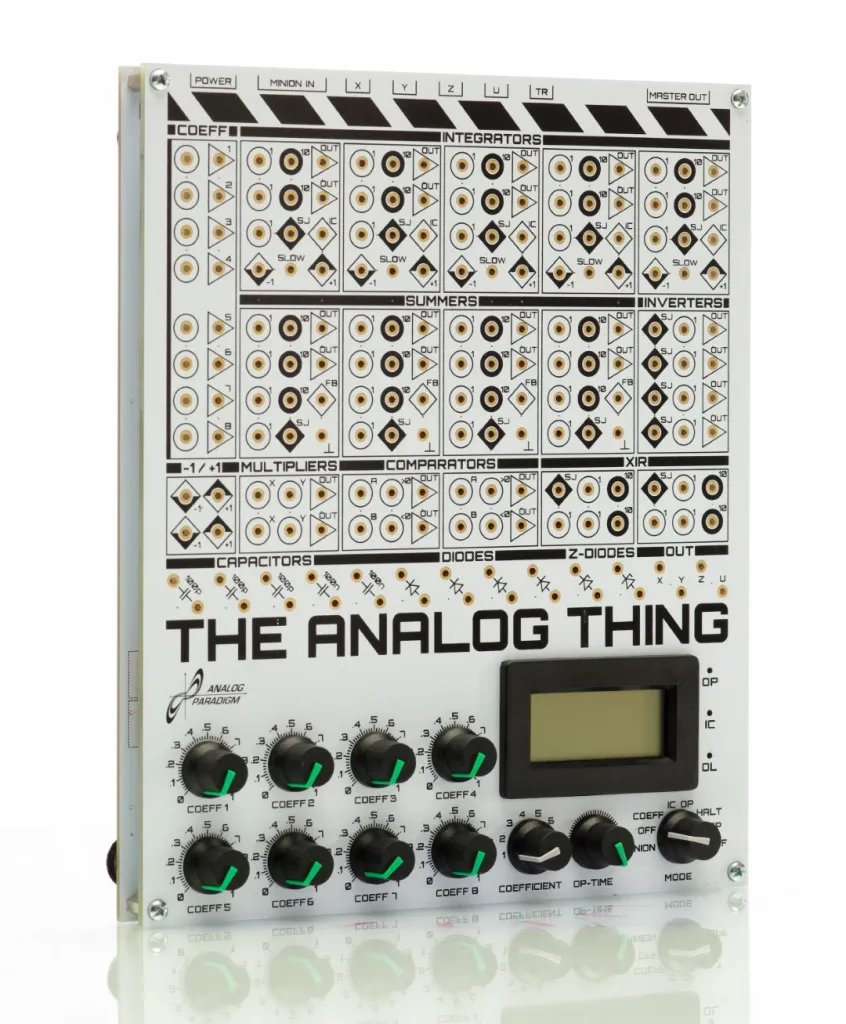
Figure 1 — THAT v1.3 at an angle, showing the full patch field: integrators (top right), summers, inverters, multipliers, comparators, machine-unit jacks (centre), capacitors, diodes (bottom strip), coefficient potentiometers and mode selector (front panel bottom).
7.6.2 The educational use case
THAT was designed explicitly for education. The First Steps manual opens with the statement that THAT is “a high-quality, low-cost, open-source, not-for-profit cutting-edge analog computer” intended to support the “comeback of analog computing.” Its fixed-element architecture and clear visual grammar (circles = inputs, triangles = outputs, diamonds = machine-unit references) align with a structured curriculum that introduces op-amp integrators, feedback, and scaling in order.
The nine worked programs in the First Steps manual span radioactive decay (first-order ODE), mass-spring-damper (second-order), lunar landing (control ODE with a comparator), neuronal bursting (Hindmarsh-Rose model, requires both multipliers and comparators), Euler spiral (five-integrator program using the full computing field), Lotka-Volterra predator-prey, Lorenz attractor, bouncing ball (with Zener diodes for impact), and polynomial generation. These programs collectively exercise every computing element on THAT at least once, making the First Steps manual itself a complete introductory curriculum.
The SLOW jack on each integrator — which connects the integrator output back to reduce operating speed to 1% of nominal — allows time-scaling demonstrations without coefficient changes: the operator can watch a fast oscillation slow down to a manually observable rate, providing direct physical intuition for time-scale factors.
The REP / REPF mode pair is essential for oscilloscope display: the machine autonomously cycles IC → OP → IC at a rate set by the OP-TIME potentiometer, creating a steady trace on a persistence oscilloscope or a triggered digital DSO without a function generator. In REPF mode (0–100 ms OP time), signals that complete a full cycle in tens of microseconds are visible without a storage scope, making high-frequency ODE demonstrations possible at modest display cost.
Newsletter #4 documents the first formal university course using THAT (Bernd Ulmann’s two-week guest professorship at University of Ulm), where students implemented a rotating Rössler attractor on two THATs in master/minion configuration. Newsletter #15 documents a public technical talk at SDD 2023 (London) using THAT live on stage. The “Sachenmachen-Tag” at Heinz Nixdorf Museums Forum (Newsletter #14) and the GPN Karlsruhe (Newsletter #8) document THAT’s use in hands-on public engagement.
The cumulative picture is of a machine that works as an introductory teaching instrument for university students, a demonstration platform for public audiences, and a research entry point for investigators new to continuous-time computing — all within a single EUR 380 device.
7.6.3 The research and prototyping use case
THAT’s HYBRID port (0–3.3 V shifted outputs from the X/Y/Z/U jacks, accessible at the rear connector) enables analog-digital hybrid programs. Newsletter #2 documents an early adapter circuit pairing THAT with an Arduino Mega 2560 as the digital partner. Newsletter #10 references community development of Rob Jansen’s Teensy-based TeensyScope (a dedicated analog-optimised display) and Michael Koch’s function generator / delay-line modules.
In a hybrid setup, THAT functions as a continuous-time ODE engine — executing integration at hardware speed — while the attached MCU handles parameter updates, mode switching, data logging, or nonlinear table lookups that would otherwise require function generator modules. This division of labour matches the classical hybrid computer architecture (EAI HYDAC, Telefunken DEX-102) in principle if not in precision.
The HYBRID port carries attenuated and shifted versions of the signals patched to the X/Y/Z/U output jacks. The shift from ±10 V analog to 0–3.3 V digital-safe range is performed by the base PCB (visible in the v1.3 base schematics). An MCU driving DAC outputs back into THAT’s patch field (via coefficient-pot inputs or direct jack connections) closes the hybrid loop, allowing the digital side to update initial conditions, switch modes, or inject externally computed nonlinear terms.
For rapid prototyping of dynamical systems models — control system design, neural oscillator exploration, chaotic system characterisation — THAT provides real-time continuous feedback that iterative digital simulation cannot replicate without specialised real-time hardware. In a 2021 application note referenced in Newsletter #2, this architecture was applied to implementing the “exponential mapped past” approach (Otterman, 1960s) for computing mean, variance, and power spectra on THAT.
Newsletter #16 (September 2023) alludes to an upcoming anabrid product with “comparable form factor to THAT, but way more powerful in every respect” — suggesting that the company intends to address the precision and capability gap above THAT while remaining in the desktop form factor. Operators working at the research edge of THAT’s capability should monitor anabrid’s product announcements accordingly.
7.6.4 The hobbyist and creative use case
The newsletters document a breadth of hobbyist use: gravitational wave chirp simulation (Michael Koch, two THATs in master/minion, Sankt Andreasberg Observatory), artistic Lissajous and spiral generation, audio synthesis coupling to voltage-controlled oscillators, and public demonstrations at the Vintage Computer Festival, GPN Karlsruhe, and TEDx Münster. THAT’s low mass (~750 g), USB power, and audio-interface compatibility make it portable in ways that no vintage machine approaches.
The RCA outputs on the rear panel (X, Y, Z, U, attenuated to ±1 V) connect directly to standard audio hardware, which means any audio-interface-equipped laptop can serve as a four-channel software oscilloscope. The trade-off is that audio interfaces couple via capacitors, filtering DC and low-frequency components — producing a qualitatively visible but quantitatively distorted view for slow phenomena (see First Steps §6.2 for the characteristic waveform comparison). For waveforms above a few hertz, the audio path is fully adequate for artistic and hobbyist purposes.
The THAT community (Facebook group, newsletters) has extended THAT into music synthesis: the ±10 V machine unit overlaps with the ±5 V or ±10 V control-voltage range of Eurorack modular synthesisers, and the HYBRID port enables MIDI-to-parameter updates via an attached MCU. Whether generating slowly evolving Lorenz attractors for visual art installations or driving audio oscillators with ODE-derived voltages, THAT occupies a productive intersection of the analog computing and electronic music communities.
7.6.5 Fit-for-purpose summary
┌──────────────────────────────────────────────────────────────────┐
│                    FIT-FOR-PURPOSE MAP                           │
│                                                                  │
│  Use case                      THAT fit    Notes                 │
│  ─────────────────────────────────────────────────────────────── │
│  Introductory ODE education     ●●●●●      Purpose-designed      │
│  Second-year controls lab       ●●●●○      Two units recommended  │
│  Chaotic systems demo           ●●●●●      Lorenz, Rössler etc.  │
│  Audio synthesis / art          ●●●●○      ±10 V matches CV gear │
│  Hybrid embedded prototyping    ●●●○○      HYBRID port; MCU needed│
│  Research (quant. precision)    ●●○○○      2 sig fig; use Model-1 │
│  High-DOF simulation (>10 ODE)  ●●○○○      Daisy-chain needed    │
│  Historical/museum display      ●○○○○      Not vintage hardware  │
│                                                                  │
│  ● = strong fit;  ○ = weak fit                                   │
└──────────────────────────────────────────────────────────────────┘
7.6.6 THAT’s position in the broader ecosystem
Newsletter #8 (June 2022) states that, at that point, “more THATs have now been sold than even the most prolific models made by Telefunken and EAI.” If accurate, this makes THAT the most widely distributed dedicated analog computer in history — a remarkable outcome for a not-for-profit open-hardware project launched without manufacturing experience.
The machine occupies a unique niche: it is simultaneously the most affordable entry point to classical analog computing, the only new-production open-hardware general-purpose analog computer at this writing, and a credible research instrument for problems solvable within five integrators and two multipliers — or within any integer multiple of those resources via daisy-chaining.
For operators whose needs eventually outgrow THAT, the natural upgrade path is the Analog Paradigm Model-1 (modular, higher precision, higher cost) or, for digital-hybrid work requiring serious computational resources, one of the FPAA or soft-core analog-simulation platforms. The programming concepts, patch discipline, and scaling methodology developed on THAT transfer directly to any of these platforms, as the computing-element grammar (summer, integrator, multiplier, comparator) is invariant across the history of electronic analog computing from the 6U8 tube to the TL074H precision op-amp.
7.7 Annotated Specification Summary
The following table consolidates all THAT parameters that have been verified from primary sources (First Steps v2 manual and v1.3 schematics). Entries marked with a dagger (†) are not explicitly stated in those sources and are noted as such.
Table 14 — Annotated Specification Summary
| Parameter | Value | Source |
|---|---|---|
| Machine unit | ±1 (physical: ±10 V) | First Steps §5 |
| Supply input | 5 V USB-C (4.5–5.5 V) | First Steps FAQ |
| Internal rail | ±12 V (from DC/DC converter) | First Steps FAQ + base schematic |
| Integrators | 5 (INT1–INT5) | Schematic, First Steps §7 |
| Summers | 4 (SUM1–SUM4) | Schematic, First Steps §7 |
| Inverters | 4 (INV1/2, INV3/4) | Schematic, First Steps §7 |
| Multipliers | 2 (MUL1/2) | Schematic, First Steps §7 |
| Comparators | 2 (CMP1/2) | Schematic, First Steps §7 |
| Coefficient pots | 8 (COEFF1–8) | Schematic, First Steps §7, 17, 23 |
| Resistor networks (XIR) | 2 (XIR1/2) | Schematic, First Steps §9 |
| Integrator inputs | 5 per integrator (×1 ×1 ×1 ×10 ×10) | First Steps §7 |
| Summer inputs | 7 per summer (×1 ×1 ×1 ×1 ×10 ×10 ×10) | First Steps §7 |
| SLOW mode factor | 0.01× (100 ms for full-scale integration) | First Steps §8 |
| REP mode OP time | 0–10 s | First Steps §15 |
| REPF mode OP time | 0–100 ms | First Steps §14–15 |
| Patch cable | 2 mm banana plug (30 pcs included) | First Steps §3, FAQ |
| Patch jacks | 186 positions | First Steps FAQ |
| RCA outputs | X, Y, Z, U (attenuated to ±1 V range) | First Steps §3, 11 |
| HYBRID port output | 0–3.3 V shifted | First Steps §5 |
| Precision (stated) | ~2 decimal places relative to ±1 mu | First Steps FAQ |
| Panel meter range (COEFF mode) | 0 to 1 | First Steps §12 |
| Panel meter range (OP/IC modes) | −1 to +1 | First Steps §12 |
| Daisy-chain | Unlimited (MASTER OUT → MINION IN) | First Steps §2 |
| Manufacture (from batch 2.0) | Neuschafer Elektronik, Germany; ISO 9001/14001 | Newsletter #10 |
| Open hardware | Yes; schematics on GitHub (anabrid/the-analog-thing) | Newsletter #7, First Steps §12 |
| Power consumption | Not specified in First Steps † | — |
| Op-amp part | TL074H (per specification; counterfeits detected in batch 1.5) | Newsletter #9 |
Comments (0)