Heathkit ES-400 · Volume 7
Heathkit ES-400 — Volume 7 — Modern extensions & interfacing
Solid-state substitution, data-logging, bench-supply alternatives, patch hardware, and reversibility discipline — bridging 1956 vacuum-tube design to modern instrumentation
7.1 About this Volume
The Heathkit ES-400 was engineered in 1956, seven years before the first monolithic operational amplifier IC arrived, eleven years before programmable bench supplies became common, and decades before USB data acquisition existed. Its signal rails swing ±100 V; its amplifier plate-supply rails reach ±250 V with an auxiliary −450 V; its sole time-base is the ES-505 repetitive oscillator running at 0.6–6 Hz. Every one of those facts creates an interface challenge when the machine is connected to twenty-first-century instrumentation.
This volume addresses four practical classes of modernization for the ES-400:
- Solid-state amplifier substitution — when and whether to replace the fifteen ES-201 vacuum-tube DC op-amps with IC or discrete solid-state equivalents, and what the tradeoffs are.
- Data-logging the output — safe, calibrated attenuation of the ±100 V signal rails into ADC-friendly levels, USB-DAQ capture, oscilloscope connection, and calibration protocol.
- Bench-supply substitution — replacing or augmenting the internal ES-2 amplifier supply (±250 V @ 250 mA, −450 V @ 50 mA) and the ES-50 reference supply (±100 V) with external regulated equipment during development or fault-finding.
- Patch-cord and banana-jack hardware — sourcing, fabricating, and documenting the jack ecosystem.
A fifth section addresses the ethics and practice of reversibility: every modification described here is designed to be undone, leaving the original chassis intact for a future curator.
Cross-references: ES-201 amplifier circuit theory and power-supply architecture are developed in Vol 2; the patch panel and computing elements are in Vol 3; full restoration procedure is in Vol 4; oscilloscope programming setups appear in Vol 5; the Heathkit EC-1 deep dive Vol 7 covers the same modernization questions for the smaller nine-amplifier sibling machine and is a useful parallel read.
Note — The only safe external connection points on the ES-400 are the 364 banana-plug jacks on the front panel and the 14 multipin connectors on the rear chassis. The ES-2 amplifier supply bus, the −450 V bias rail, and all internal wiring are unguarded and lethal. Nothing in this volume authorizes probing inside a powered chassis without the explicit isolation procedure described in §6.
7.2 Solid-State Amplifier Substitution
7.2.1 Why the Question Arises
Fifteen ES-201 op-amp modules — each containing a 12AX7 dual triode, a 6BQ7 dual triode, and a 6BH6 pentode — form the computing heart of the ES-400. The 12AX7 remains in full current production (multiple manufacturers). The 6BQ7 and 6BH6 are available as new-old-stock (NOS), though supply will diminish over time. Restorers occasionally ask whether a solid-state substitute — a high-voltage IC op-amp or a discrete BJT/FET stage — could replace one or more ES-201 modules, either to extend service life, eliminate the tube-search burden, or explore the technology comparison.
The answer is nuanced. Substitution is feasible in principle but involves non-trivial constraints: the ES-400 operates at ±100 V signal rails, requires the full ±100 V swing for every problem setup in the original manual, and is mechanically organized around the removable ES-201 plug-in module format.
7.2.2 The ES-201 Op-Amp — Verified Electrical Parameters
The following values are drawn from the Operational Manual and the ES-201 Service Manual:
Table 1 — The following values are drawn from the Operational Manual and the ES-201 Service Manual
| Parameter | Verified Value | Source |
|---|---|---|
| Open-loop gain | ~50,000 (94 dB) | Research Guide §2; ES-201 SM |
| Signal output range | ±100 V | Research Guide §2 |
| Output current capability | 10 mA continuous | Research Guide §2 |
| Plate supply | ±250 V (ES-2) | Research Guide §2 |
| Auxiliary bias rail | −450 V (ES-2) | Research Guide §2 |
| Tube complement per module | 12AX7 + 6BQ7 + 6BH6 + NE-51 | Research Guide §2 |
| Overload indicator | NE-51 neon lamp (lights at output saturation) | Research Guide §2 |
| Integrator time constant | 1 s with 1 MΩ input / 1 µF feedback | Research Guide, Appendix A |
The ±100 V signal swing is the critical constraint. All 30 coefficient potentiometers, all 14 resistor/capacitor plug values, and all scaling in the original problem library are calculated for that range. A substitute delivering only ±15 V would require rescaling every coefficient by a factor of 6.7 — effectively rebuilding every documented problem setup from scratch.
7.2.3 Candidate Solid-State Approaches
Three distinct strategies apply, each with different scope and tradeoffs:
Strategy A — High-Voltage Monolithic Op-Amp
Very few monolithic op-amps tolerate the supply voltages necessary to deliver ±100 V output. The relevant parts cluster in two families:
Table 2 — Very few monolithic op-amps tolerate the supply voltages necessary to deliver ±100 V output. The relevant parts cluster in two families
| Part | Manufacturer | Max Supply (±V) | Vout Swing | Ibias | Notes |
|---|---|---|---|---|---|
| LTC6090 | Analog Devices | ±70 V (140 V total) | Rail − 1.5 V | 5 pA | DIP-8 available; strong candidate at ±65 V supply |
| ADHV4702-1 | Analog Devices | ±110 V | Rail − 15 V | 3 pA | Wide margin; limited stock; only ±95 V swing at ±110 V |
| PA85 | Apex Microtechnology | ±150 V | Rail − 5 V | 50 pA | Discrete HV op-amp; ~$60; wide margin |
| PA88 | Apex | ±175 V | Rail − 5 V | 20 pA | Maximum headroom; most expensive |
| OPA445 | Texas Instruments | ±45 V | Rail − 2 V | 10 pA | Insufficient — ±43 V swing, short of ±100 V requirement |
| OPA452 | Texas Instruments | ±40 V | Rail − 2 V | 5 nA | Insufficient supply headroom |
The LTC6090 is the most practical single-chip choice if an auxiliary ±65 V supply (stepped down from the ES-2’s ±250 V rails via dropping resistors or a small series regulator) is provided. It cannot swing the full ±100 V, so problem scaling must be adjusted by a factor of ≈1.5 throughout — less disruptive than a ±15 V part, but still a break from original documentation. The Apex PA85 or PA88 on a ±120 V auxiliary supply can swing ±115 V and needs no rescaling.
Strategy B — Discrete Transistor Stage
A classic two-stage BJT amplifier using MPSA42/MPSA92 high-voltage transistor pairs can achieve ±100 V output at 10 mA from a ±120–±150 V supply. This approach has been documented in vintage-computer restoration communities and can be made to fit in a module footprint matching the ES-201 plug-in format. Open-loop gain with this topology typically reaches 60–80 dB — adequate to replicate the ES-201’s closed-loop behaviour with the original feedback networks. The main liability is the design effort: a stable, low-drift discrete DC amplifier at ±100 V requires careful attention to thermal compensation and offset trimming.
Strategy C — Hybrid: Retain ES-201, Replace Individual Tubes
This is the most conservative option and the one recommended for any machine intended for regular operation. The 12AX7 is in full production; the 6BH6 is a common IF-amplifier tube available as NOS; the 6BQ7 is still findable. The Goodsell restoration replaced all 45 active tubes and documented no difficulty sourcing them. Retaining the ES-201 modules unmodified means the original calibration, balance, and service procedures remain fully applicable.
7.2.4 What Is Lost in Solid-State Substitution
Even a technically competent solid-state substitution sacrifices several authentic properties:
Table 3 — Even a technically competent solid-state substitution sacrifices several authentic properties
| Loss | Engineering Impact | Aesthetic / Historical Impact |
|---|---|---|
| Tube warm-up period (10–15 min) | Faster availability | No warm-up ritual; drift character changes |
| 73-tube visual complement (45 external) | Nine / fifteen dark sockets | Significant for demonstration context |
| Authentic noise floor | IC noise is typically lower; small discrepancy in published setups | Subtle |
| Mechanical plug-in ES-201 format | Must fabricate a physically compatible substitute card | Non-trivial |
| Originality for museum / appraisal | Significantly reduced | Major for collectors; affects value |
| NE-51 overload indication | Must replicate with LED or comparator circuit | Minor functionally |
Note — The ES-201 open-loop gain of ~50,000 is higher than the 6U8-based EC-1 amplifier (~1,000). This means the ES-400 can tolerate somewhat higher closed-loop gains without excess offset error. A solid-state substitute should achieve at least 80 dB (10,000×) open-loop to match the ES-201’s closed-loop accuracy in high-gain configurations.
7.2.5 Mechanical Substitution Architecture
The ES-201 is a plug-in module with a defined card-edge or connector footprint. Any solid-state substitute must:
- Physically fit the ES-201 mounting bay and connector.
- Present an appropriate heater-current load to the ES-2 heater winding (or bypass the heater circuit with a dummy load resistor — 6.3 V × heater current per tube × 3 tubes per module).
- Draw plate current from the ES-2 supply in the expected range, or provide its own regulated supply derived from the ±250 V rails via dropping resistors.
┌─────────────────────────────────────────────────────────────────────┐
│        SOLID-STATE ES-201 SUBSTITUTE — CONCEPTUAL ARCHITECTURE      │
│                                                                     │
│  ES-201 Connector                                                   │
│  ─────────────                                                      │
│  Input summing junction ──────────► [Precision divider to ±15 V]   │
│                                             │                       │
│  ±250 V rails ──► [Dropping + regulator] ──► ±120 V aux supply     │
│                                             │                       │
│                                       [PA85 or LTC6090]            │
│                                             │                       │
│                                    [×8.3 output stage]             │
│                                    (if LTC6090 at ±65 V)           │
│                                             │                       │
│  Heater pins ──► [Dummy load: 7 Ω / 20 W per tube × 3] ────────── │
│                                             │                       │
│  Output ───────────────────────────────────►  ±100 V (or ±65 V)   │
│  NE-51 equivalent ──► [LED + comparator at ±95% rail] ────────────  │
└─────────────────────────────────────────────────────────────────────┘
7.2.6 Recommendation
For a working restoration intended for programming demonstrations, retain the original ES-201 modules with fresh 12AX7, 6BQ7, and 6BH6 tubes. The tubes are available; the modules balance reliably with the original potentiometer adjustment; and they define the machine. Chinese new-production 12AX7 tubes (available from Antique Electronic Supply / TubesAndMore.com at ~$9.59 each) have performed well in the Goodsell restoration.
For an educational electronics project specifically exploring the tube-to-IC transition, a reversible daughter-card substitution for one ES-201 module using the PA85 at ±120 V is the most technically faithful approach. Document every modification, retain the original modules and tubes, and label any substitute card clearly. Under no circumstances modify the ES-201 PCB itself — the goal is a removable card, not a permanent conversion.
Tip — A useful middle path: build a standalone ±100 V solid-state amplifier on a separate breadboard, patch its input and output to the ES-400 via front-panel banana jacks, and run it in parallel with one ES-201 module. This demonstrates the equivalence without touching the ES-201 chassis at all.
7.3 Data-Logging the Output
7.3.1 The Voltage-Level Problem
The ES-400’s front-panel output jacks swing between approximately −100 V and +100 V, relative to the computer’s signal ground. Every modern ADC, oscilloscope input on ×1 range, microcontroller ADC, and USB data-acquisition module operates at voltages between −10 V and +10 V at best; most single-supply embedded ADCs accept only 0 to 3.3 V or 0 to 5 V.
Direct connection of any ES-400 output to modern low-voltage hardware will destroy the hardware. A precision attenuation and buffering interface is mandatory.
The Research Guide (§9) documents the basic approach: a resistive divider of 180 kΩ / 10 kΩ scales ±100 V to approximately ±5.26 V. This volume refines that design into a production-ready, calibrated interface.
7.3.2 Ground Reference — Critical Warning
Danger — The ES-400’s signal ground (black banana jacks on the front panel) is chassis ground, connected to the AC safety earth through the power cord. USB-DAQ devices, oscilloscopes, and laptops each have their own chassis ground, also earth-connected. If the ES-400 signal ground and the instrument ground are at different earth potentials — for example, because the ES-400 is on an isolation transformer or on a different branch circuit — a ground loop forms that may deliver fault current through interface cabling and damage inputs. Before connecting any external instrument, verify that the ES-400 and the instrument share the same AC outlet strip, or use an instrument with a differential input rated for common-mode voltages.
7.3.3 Oscilloscope Connection — 10× Probe Method
The simplest capture method requires no additional circuitry: a standard 10× oscilloscope probe contains a built-in 9 MΩ series resistor that, combined with the scope’s 1 MΩ input, forms a 10:1 divider. With a 10× probe, the scope displays 1 V per actual volt applied. At 100 V full scale the scope sees 10 V — well within the capability of any modern instrument on the 10 V/div range.
Probe connection at the ES-400: Use a banana-to-grabber adapter (Pomona 3782-0 or equivalent). Clip the probe ground lead to an ES-400 black binding post; clip the probe tip to the desired output red jack.
Table 4 — 3.3 Oscilloscope Connection — 10× Probe Method
| Scope Setting | Value | Rationale |
|---|---|---|
| Coupling | DC | AC coupling blocks the slowly varying DC signal content |
| Probe ratio setting | ×10 | Must be set on scope — not just physically attached |
| V/div | 10 V/div (with ×10 probe → reads 100 V/div actual) | Shows ±100 V in 10 divisions |
| Time base | 0.1–10 s/div | ES-400 repetitive rate: 0.6–6 Hz per ES-505 |
| Input impedance | 1 MΩ | |
| Mode (for trajectory display) | X-Y | Connect two amplifier outputs to CH1/CH2 for planar trajectories |
Danger — Do not connect the oscilloscope’s ground clip (BNC shield / probe chassis) to any ES-400 terminal other than the signal ground black jacks. The ES-400’s ±250 V and −450 V rails are not accessible at the front-panel jacks under normal operation, but accidental contact during probing inside an open chassis is possible. Ground the oscilloscope and the ES-400 to the same AC outlet strip before connecting probes.
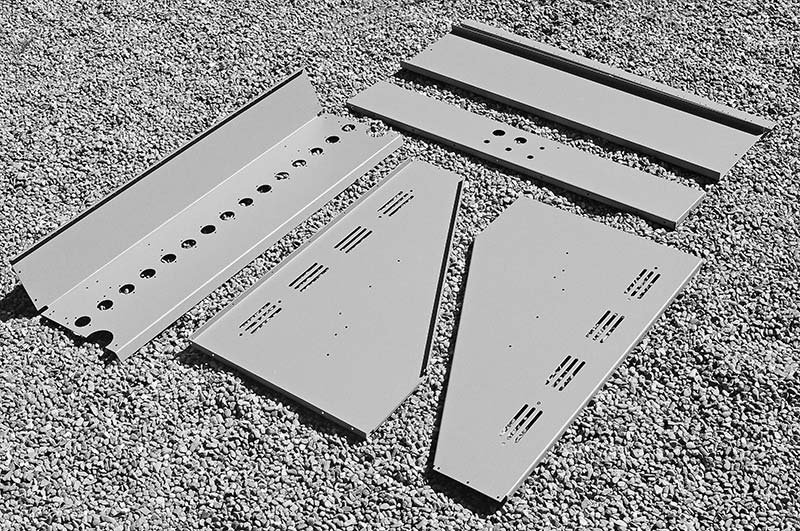 (reference — courtesy Nuts & Volts / David Goodsell)
7.3.4 Resistive Voltage Divider — Design
The Research Guide documents a 180 kΩ / 10 kΩ divider for the ±100 V → ±5.26 V conversion. The exact output voltage and output impedance are:
ES-400 output (±100 V)
        │
       [R1: 180 kΩ, 1%, 0.5 W, ≥200 V rated]
        │
        ├─────────────────────────────────► To buffer input / ADC (±5.26 V)
        │
       [R2: 10 kΩ, 1%, 0.25 W]
        │
    ES-400 GND (black banana post)
Attenuation ratio: R2 / (R1 + R2) = 10 / 190 = 0.0526 At ±100 V input: output = ±5.26 V Divider output impedance: R1 ∥ R2 = 180k × 10k / 190k = 9.47 kΩ
The 9.47 kΩ output impedance is acceptable for scope inputs (≥1 MΩ) but problematic for ADC sample-and-hold inputs that draw brief charge pulses. An op-amp buffer in unity-gain configuration is strongly recommended for ADC connections.
Danger — R1 must be rated for the full voltage across it. At 100 V input, R1 sees approximately 94.7 V; at the −450 V bias rail (internal, not normally accessible at jacks), the situation is far worse. Use 0.5 W metal-film resistors rated ≥200 V. Standard 1/4 W carbon resistors rated 50–75 V must not be used in this application.
7.3.5 Complete Buffered Attenuator Interface
The recommended interface adds a unity-gain buffer stage and a Schottky clamp to protect the downstream ADC:
7.3.6 Component Bill of Materials — Attenuator Interface Board (4-channel)
Table 5 — 3.6 Component Bill of Materials — Attenuator Interface Board (4-channel)
| Ref | Part | Value / Part No. | Qty | Supplier | Approx Cost |
|---|---|---|---|---|---|
| R1 × 4 | Metal-film resistor | 180 kΩ, 1%, 0.5 W, 250 V | 4 | Digi-Key MFR-25FBF52-180K | $0.20 ea |
| R2 × 4 | Metal-film resistor | 10 kΩ, 1%, 0.25 W | 4 | Digi-Key MFR-25FBF52-10K | $0.12 ea |
| U1 | Quad op-amp | TL074CN (DIP-14) | 1 | Digi-Key 296-1836-5-ND | $0.75 |
| U2 | Precision dual op-amp | OPA2134PA (DIP-8, optional upgrade) | 1 | Digi-Key OPA2134PA/2K5 | $4.50 |
| D1–D4 | Schottky clamp | BAT54S SOT-23 dual Schottky | 4 | Digi-Key BAT54SFILM-ND | $0.30 ea |
| PS1 | DC-DC converter | Traco TMA 1515D (±15 V, 1 W) | 1 | Digi-Key 1034-1045-ND | $9.00 |
| J1–J4 | Banana jacks (red) | 4 mm panel-mount | 4 | Digi-Key J161-ND | $1.50 ea |
| J5–J8 | Banana jacks (black) | 4 mm panel-mount | 4 | Digi-Key J160-ND | $1.50 ea |
| J9–J12 | BNC jack | Panel-mount 50 Ω | 4 | Mouser 523-31-221-RFX | $2.00 ea |
| PCB | Perfboard | 0.1” pitch, 4 × 5 in | 1 | Amazon or Digi-Key | $3.00 |
Total BOM cost (four channels): approximately $45–55 depending on sourcing.
7.3.7 USB Data-Acquisition Capture
After passing through the attenuator board, the ±5.26 V (or rescaled) signal can be connected to any general-purpose USB-DAQ. Suitable devices:
Table 6 — After passing through the attenuator board, the ±5.26 V (or rescaled) signal can be connected to any general-purpose USB-DAQ. Suitable devices
| Device | Ch | Sample Rate | Resolution | Vrange | Cost |
|---|---|---|---|---|---|
| Measurement Computing USB-1208FS | 8 SE / 4 diff | 50 kS/s | 12-bit | ±5 V diff | ~$180 |
| NI USB-6001 | 8 AI (±10 V) | 20 kS/s | 14-bit | ±10 V | ~$220 |
| Digilent MCC 118 (Raspberry Pi HAT) | 8 SE | 100 kS/s | 12-bit | ±5 V | ~$99 |
| ADS1115 breakout (I²C, RPi/Arduino) | 4 diff | 860 S/s | 16-bit | ±6.144 V | ~$8 |
| Arduino Uno (built-in ADC) | 6 AI | 9.6 kS/s | 10-bit | 0–5 V | ~$25 |
The ES-400’s useful signal bandwidth is determined by the ES-201 op-amp frequency response; no specific −3 dB bandwidth is stated in the available sources, but the machine was designed for computations whose time constants range from 0.1 s to many seconds. Even the slowest USB-DAQ listed (860 S/s ADS1115) samples the ES-400’s signal content at many multiples of Nyquist. For repetitive-mode X-Y capture (6 Hz maximum repetition rate per ES-505), sample at a minimum of 100 S/s; 1,000–2,000 S/s provides a smooth waveform.
Python data-logging example (ADS1115 via I²C on Raspberry Pi):
# Requires: pip install adafruit-circuitpython-ads1x15
# Hardware: ADS1115 on I2C; attenuator board output to ADS1115 A0/GND
import board, busio, time, csv
import adafruit_ads1x15.ads1115 as ADS
from adafruit_ads1x15.analog_in import AnalogIn

i2c   = busio.I2C(board.SCL, board.SDA)
ads   = ADS.ADS1115(i2c)
chan  = AnalogIn(ads, ADS.P0)

SCALE = 190.0 / 10.0   # invert the 10k/(180k+10k) divider
                        # multiply ADS voltage to recover true ES-400 voltage

with open("es400_log.csv", "w", newline="") as f:
    wr = csv.writer(f)
    wr.writerow(["t_s", "v_adc_V", "v_es400_V"])
    t0 = time.monotonic()
    while True:
        v_adc  = chan.voltage           # ±6.144 V full scale for ADS1115
        v_es400 = v_adc * SCALE         # recover true ES-400 signal voltage
        wr.writerow([f"{time.monotonic()-t0:.4f}",
                     f"{v_adc:.5f}", f"{v_es400:.3f}"])
        time.sleep(0.005)               # 200 S/s
The Research Guide (§9) documents a similar approach using a Raspberry Pi and ADS1115; the code above formalizes that concept with a calibration scalar.
7.3.8 Hybrid Computer Architecture — ES-400 + Microcontroller
The Research Guide (§9) describes a compelling extension: a true hybrid computer combining the ES-400’s continuous analog solving with a Raspberry Pi (or similar) for event detection and output driving. The signal chain:
┌──────────────────────────────────────────────────────────────────────┐
│               ES-400 / RASPBERRY PI HYBRID LOOP                      │
│                                                                      │
│  ES-400                Attenuator           Raspberry Pi             │
│  (analog solver)       board                (digital controller)     │
│  ───────────           ─────────            ────────────────         │
│                                                                      │
│  Integrator 1 out ──► 180k/10k div ──► ADS1115 A0 ──► Python ADC   │
│  Integrator 2 out ──► 180k/10k div ──► ADS1115 A1 ──► event detect │
│                                                                      │
│  Python DAC (MCP4725) ──► ×20 HV amplifier ──► ES-400 IC jack      │
│                            (OPA445 + bipolar stage, ±45 V max)      │
│                            or discrete MPSA42/92 stage (±100 V)     │
│                                                                      │
│  Logic: detect "ball hits floor" → assert reset signal → ES-400 relay│
│         → ES-505 advances to next sweep → loop continues            │
└──────────────────────────────────────────────────────────────────────┘
The ES-505 repetitive oscillator already resets the integrators automatically; the hybrid extension adds intelligence — detecting threshold crossings and modifying initial conditions in response. This replicates, in miniature, the hybrid computing facilities of 1960s aerospace simulation centers where analog machines solved the continuous physics and digital machines managed the logic.
Note — The output amplifier driving ES-400 inputs must swing to ±100 V to be compatible with the coefficient potentiometer range. The OPA445 is rated to ±45 V supply (±43 V swing) — insufficient for the full range; the discrete MPSA42/MPSA92 stage is necessary for full ±100 V output to the ES-400. For low-amplitude forcing functions (±10 V), the OPA445 or any ±15 V op-amp followed by a coefficient pot that scales the signal back up is a practical workaround.
7.3.9 Interface Calibration Procedure
Before trusting logged data, calibrate the attenuator chain against a known reference:
- Apply a known DC voltage (e.g., +50.00 V verified with a 4.5-digit DMM) to the channel input banana jacks.
- Record the ADC reading in software.
- Compute the actual attenuation ratio: ratio = V_reference / V_adc.
- Apply ratio as a scalar correction factor in the logging script.
- Repeat at −50.00 V to check for asymmetry (indicates op-amp input offset or resistor mismatch).
- Verify at +100.00 V and −100.00 V to confirm the clamp diodes are not conducting at full scale.
Typical residual error after calibration: ±0.5% (limited by 1% resistors and op-amp offset voltage).
Table 7 — 3.9 Interface Calibration Procedure
| Test Point | Applied (V) | Expected ADC output (V) | Acceptable Tolerance |
|---|---|---|---|
| + full scale | +100.00 | +5.26 | ±0.05 V (±1%) |
| + half scale | +50.00 | +2.63 | ±0.03 V (±1%) |
| Zero | 0.00 | 0.00 | ±0.01 V (±0.2%) |
| − half scale | −50.00 | −2.63 | ±0.03 V (±1%) |
| − full scale | −100.00 | −5.26 | ±0.05 V (±1%) |
7.4 Bench-Supply Substitution for the ES-400 HV Rails
7.4.1 When Substitution Is Appropriate
The ES-400’s ES-2 amplifier power supply is the most complex and heaviest assembly in the machine (weighing approximately 43 lbs on its own). Three scenarios motivate bench-supply substitution or augmentation:
- Fault-finding during restoration — before the ES-2 is verified, an external regulated supply allows safe stepwise energization of individual ES-201 amplifier stages and identification of faulty modules without risk to a marginal internal supply.
- ES-2 failure during operation — if a component in the ES-2 fails and the machine is needed for a demonstration, an external supply can maintain operation temporarily.
- Teaching power supply design — intentionally varying B+ voltage while observing amplifier output offset illustrates PSRR and regulation principles; an external supply makes this safe and adjustable.
7.4.2 ES-400 Internal Supply Summary — Verified Values
The following values are sourced from the Research Guide (§2) and confirmed against the Operational Manual (p. 9):
Table 8 — The following values are sourced from the Research Guide (§2) and confirmed against the Operational Manual (p. 9)
| Assembly | Rail | Nominal Voltage | Max Current | Purpose |
|---|---|---|---|---|
| ES-2 | +250 V | +250 V DC (regulated) | 250 mA | Plate supply — all 15 ES-201 op-amps |
| ES-2 | −250 V | −250 V DC (regulated) | 250 mA | Negative plate supply — all ES-201 |
| ES-2 | −450 V | −450 V DC | 50 mA | Bias supply — ES-201 grid bias circuits |
| ES-2 | 6.3 VAC | 6.3 V AC | 14.5 A | All tube heaters (45 active tubes + auxiliaries) |
| ES-50 | +100 V | +100 V DC (regulated) | — | Positive reference supply |
| ES-50 | −100 V | −100 V DC (regulated) | — | Negative reference supply |
| ES-100 (×3) | 2 × floating 100 V | ±100 V per supply | — | Initial-condition supplies (2 per ES-100 × 3) |
| ES-151 | 2 × 50 V | 50 V × 2 | — | Relay power supply |
Danger — The ES-2 −450 V bias rail is lethal. It exceeds the threshold at which ventricular fibrillation can be caused by contact with a single finger. This rail is internal to the ES-2 and is not normally accessible at front-panel jacks, but it must be accounted for in any bench-supply substitution scheme. A bench supply substituting the −450 V rail must be treated with the same precautions as the B+ rail.
7.4.3 ES-400 Power Distribution — Block Diagram
┌──────────────────────────────────────────────────────────────────────────────┐
│                    ES-400 POWER DISTRIBUTION TREE                            │
│                                                                              │
│  110 VAC / 60 Hz ──► ES-401 voltage regulator transformer (250 VA) ────┐    │
│                                                                         │    │
│                                                          Main ON/OFF    │    │
│                                                          switch ────────┘    │
│                                                               │              │
│                                                        ES-2 sub-assembly    │
│                                                        (~43 lbs)            │
│                                              ┌─────────────┤              │
│                                              │                              │
│                              ┌───────────────┼───────────────────────┐      │
│                              │               │                       │      │
│                              ▼               ▼                       ▼      │
│                    HV secondary         HV secondary            Heater     │
│                    (→ +250 V reg.)      (→ −250 V reg.)         secondary  │
│                              │               │                  6.3 VAC    │
│                              │               │                  @ 14.5 A   │
│                    16 electrolytic     16 electrolytic               │      │
│                    caps (20–70 µF      caps (20–70 µF            To all    │
│                     @ 350 V each)       @ 350 V each)           45 tubes   │
│                              │               │                   (series-  │
│                              ▼               ▼                  parallel)  │
│                        +250 V bus      −250 V bus                         │
│                        250 mA max      250 mA max                         │
│                              │               │                              │
│                              └──────┬────────┘                             │
│                                     ▼                                       │
│                        −450 V bias (50 mA)                                │
│                                     │                                       │
│                        ┌────────────┴──────────────────────┐               │
│                        ▼                       ▼            ▼               │
│                  15× ES-201           ES-50 (±100 V ref)  ES-100 ×3        │
│                  op-amp modules        ES-151 (relay)     (IC supplies)    │
└──────────────────────────────────────────────────────────────────────────────┘
7.4.4 External B+ Supply Requirements
A replacement or supplemental +250 V supply must satisfy the following verified requirements:
Table 9 — A replacement or supplemental +250 V supply must satisfy the following verified requirements
| Parameter | Requirement | Basis |
|---|---|---|
| Output voltage | +250 V DC nominal (adjustable +200–+300 V preferred) | ES-2 specification |
| Current capacity | 300 mA minimum (250 mA for ES-201 load + 20% margin) | ES-2 specification |
| Load regulation | < 1% from 50 mA to 250 mA | Required for amplifier offset stability |
| Ripple | < 20 mV peak-to-peak at 120 Hz | Excess ripple appears as 120 Hz noise on all 15 amplifier outputs |
| Short-circuit protection | Current limiting at 400–500 mA | Protects against wiring errors during development |
| Output impedance | < 50 Ω at 120 Hz | Maintains regulation against heater-induced modulation |
Recommended external HV supply options:
Table 10 — Recommended external HV supply options:
| Supply | Vout Range | Iout | Notes | Approx Cost |
|---|---|---|---|---|
| Keysight N5752A | 0–600 V | 0–1.25 A | Lab grade; full protection | ~$800 used |
| BK Precision 1787B | 0–500 V | 0–120 mA | Affordable; adequate for ES-400 | ~$350 new |
| Matsusada AU-300P1 | 0–300 V | 0–1 A | Well regarded; Japanese | ~$500 new |
| Agilent E3612A | 0–60 V | 0–2 A (insufficient alone) | Requires series stacking for >60 V | ~$200 used |
| DIY tube rectifier supply | +200–+300 V | 350 mA | KT88/EL34-based; period-appropriate | Parts ~$100 |
| Rod Elliott P39 CRC supply | Adjustable | 200 mA | PCB available; solid-state | Parts ~$70 |
Danger — Any bench supply delivering +250 V must have its output connected to the ES-400 through a 560 Ω / 10 W current-limiting resistor during initial power-up (capacitor forming). Remove the resistor only after verifying that current draw is stable and within specification. A +250 V terminal can deliver a potentially lethal shock. Maintain the one-hand rule: one hand in a pocket, probe with the other using insulated test leads only.
7.4.5 Heater Supply — Substitution Notes
The ES-2 heater supply delivers 6.3 VAC at 14.5 A to the full tube complement. The verified tube list per ES-201 module is: 12AX7 (0.3 A), 6BQ7 (0.45 A), 6BH6 (0.3 A). For 15 modules: 15 × (0.3 + 0.45 + 0.3) = 15.75 A, with additional current for power-supply tubes. The 14.5 A rating in the Research Guide is consistent with this; a heater transformer failure is unlikely to require substitution in a freshly restored machine, but the following substitution options exist if the ES-2 heater winding opens:
Table 11 — The ES-2 heater supply delivers 6.3 VAC at 14.5 A to the full tube complement. The verified tube list per ES-201 module is: 12AX7 (0.3 A), 6BQ7 (0.45 A), 6BH6 (0.3 A). For 15 modules: 15 × (0.3 + 0.45 + 0.3) = 15.75 A, with additional current for power-supply tubes. The 14.5 A rating in the Research Guide is consistent with this; a heater transformer failure is unlikely to require substitution in a freshly restored machine, but the following substitution options exist if the ES-2 heater winding opens
| Substitute | Rating Required | Notes |
|---|---|---|
| Antek AN-0516 toroidal | 6.3 VAC / 16 A | Drop-in replacement transformer secondary |
| Hammond 166J6 | 6.3 VAC / 10 A | Lower rating — requires selective module energization |
| 6.3 V DC regulated | 15 A DC linear regulator | Eliminates 60 Hz hum coupling; requires 95 W regulator |
A 6.3 V / 10 Ω series resistor should be placed in the heater circuit during initial substitution power-on to limit the cold-start inrush, which is approximately 5× the steady-state current due to low cold resistance of tube heaters.
7.4.6 Variac Forming Procedure for Stored Capacitors
The ES-2 contains 16 large axial electrolytic capacitors (20–70 µF @ 350 V each) that must be reformed if the machine has been in storage. The controlled bench-supply procedure is more precise than a Variac:
- Set the bench supply to +50 V DC, current limit at 10 mA. Connect to the ES-2 B+ bus via a temporary 1 kΩ / 5 W series resistor.
- Raise output by 25 V every 15 minutes while monitoring current. If current rises above 10 mA at any step, hold at that voltage until current falls below 3 mA.
- Continue: +75 V → +100 V → +150 V → +200 V → +250 V over 3–4 hours total.
- At +250 V, verify regulation with a DMM and confirm ripple (AC-coupled scope) is below 20 mV peak-to-peak.
- Remove the series resistor. The ES-2 is ready for amplifier balancing.
Apply the same graduated procedure to the −250 V rail using a negative bench supply.
7.5 Patch Hardware Sourcing
7.5.1 The Banana-Jack Ecosystem — Standard and Accessible
The ES-400’s 364 front-panel jacks are standard 4 mm (0.157”) banana jacks throughout — the same format used in laboratory test equipment worldwide since the 1950s. This is fortunate: 4 mm banana plugs are a live international standard (IEC 61010-031) and are manufactured continuously by dozens of suppliers. The barrier to entry for modern patch cords is zero.
The Operational Manual (p. 12) specifies that patch cord capacitors and resistors used in the Computing Elements sockets are inserted via “4 mm banana-type connectors.” The Research Guide (§7) documents the standard cord color conventions used in the original machine:
Table 12 — The Operational Manual (p. 12) specifies that patch cord capacitors and resistors used in the Computing Elements sockets are inserted via "4 mm banana-type connectors." The Research Guide (§7) documents the standard cord color conventions used in the original machine
| Color | Conventional Use |
|---|---|
| Black | Signal ground / reference return |
| Red | Positive voltages; positive signal paths |
| Yellow or Green | Signal cables between amplifiers |
| White or other | Coefficient or auxiliary connections |
7.5.2 Patch Cord Specifications
The ES-400 operates at ±100 V on its signal rails. Standard laboratory patch cords are rated 600–1,000 V (well above the signal level) but the insulation rating must be verified before purchase. Budget cords with 50 V or 75 V insulation ratings must not be used.
Table 13 — 5.2 Patch Cord Specifications
| Parameter | Requirement | Rationale |
|---|---|---|
| Plug diameter | 4 mm standard banana | Matches all 364 front-panel jacks |
| Conductor | 22 AWG minimum | 10 mA max signal current; 22 AWG provides safe margin |
| Insulation voltage | ≥ 300 V | Signal swings ±100 V; 3× margin required |
| Length assortment | 3”, 6”, 12”, 18”, 24” | Short: same-module jumpers; long: cross-panel routing |
| Color | Red and black minimum; add yellow, green for signal paths | Per original convention |
| Plug body | Fully insulated to plug root | No exposed conductor within reach at 100 V |
Sourcing:
Table 14 — Sourcing:
| Supplier | Part / Series | Insulation Rating | Notes |
|---|---|---|---|
| Pomona Electronics | 5322 series (various lengths) | 1,000 V / 15 A | Industry standard; highly recommended |
| Mueller Electric | BU-00260 / BU-00261 | 600 V | Economy; adequate rating |
| Stäubli (Multilam) | KAB / TKL series | 1,000 V | Premium laboratory grade; expensive |
| Digi-Key | Pomona 501-1283-ND (5322-48-2, 48”) | 1,000 V | Stock item; ships next day |
| eBay / Amazon | Various Asian brands | Verify before buying | Insulation rating often unstated; request datasheet |
Recommended starter set for one ES-400 (56 cords): 10 × 3” red, 10 × 3” black, 8 × 6” red, 8 × 6” black, 6 × 12” red, 6 × 12” black, 6 × 18” red, 4 × 18” black, 2 × 24” red, 2 × 24” black. Approximate cost: $60–$100 using Pomona 5322 series.
7.5.3 Passive Component Plugs — Resistors and Capacitors
The Operational Manual (p. 12) states that Computing Elements components (resistors, capacitors) are installed directly into the front-panel jacks using the component’s own leads as banana plugs, not via a separate proprietary plug body as on the EC-1. This is a significant advantage: ES-400 restorers do not face the EC-1’s proprietary two-pin plug problem.
Note — The EC-1 uses proprietary two-pin phenolic plug bodies (no longer manufactured) to hold its programming resistors and capacitors. The ES-400’s direct-lead-insertion approach means any standard resistor or capacitor of the correct value can be inserted directly. This is a meaningful practical advantage for modern operators. See the Heathkit EC-1 deep dive Vol 7 for a detailed discussion of the EC-1 plug reproduction problem.
Voltage ratings for computing element components:
Table 15 — Voltage ratings for computing element components:
| Element | Location | Voltage seen | Required part rating |
|---|---|---|---|
| Input resistor | Summing junction | Up to ±100 V | ≥ 200 V; 0.5 W metal film, 1% |
| Feedback resistor | Amp output to junction | Up to ±100 V | ≥ 200 V; 0.5 W metal film, 1% |
| Integrator capacitor | Feedback path | Full output swing ±100 V (200 V p-p) | ≥ 400 V rating; polypropylene or polystyrene film preferred |
| Coefficient pot wiper | ±100 V signal | ±100 V | N/A — front-panel pots are rated by Heath |
Standard 50 V or 100 V capacitors must not be used in integrator feedback positions. The Goodsell restoration used 1% metal-film resistors throughout, replacing original carbon composition types that had drifted.
7.5.4 Recommended Component Library
A working library of plug-in computing elements for the ES-400:
Table 16 — A working library of plug-in computing elements for the ES-400
| Value | Type | Qty Recommended | Voltage Rating |
|---|---|---|---|
| 100 kΩ | Metal-film resistor, 1%, 0.5 W | 20 | ≥ 200 V |
| 200 kΩ | Metal-film resistor, 1%, 0.5 W | 10 | ≥ 200 V |
| 500 kΩ | Metal-film resistor, 1%, 0.5 W | 10 | ≥ 200 V |
| 1 MΩ | Metal-film resistor, 1%, 0.5 W | 20 | ≥ 200 V |
| 2 MΩ | Metal-film resistor, 1%, 0.5 W | 10 | ≥ 200 V |
| 5 MΩ | Metal-film resistor, 1%, 0.5 W | 5 | ≥ 200 V |
| 0.1 µF | Polypropylene film capacitor | 10 | ≥ 630 V |
| 1.0 µF | Polypropylene film capacitor | 10 | ≥ 630 V |
The 630 V capacitor rating provides a 3× safety margin over the 200 V peak-to-peak signal swing and eliminates any risk of capacitor dielectric breakdown at normal operating voltages.
7.5.5 Patch Cord Documentation Protocol
The ES-400’s “program” exists entirely in its patch state: which jacks are connected, which component values are installed, and where the potentiometers are set. When a problem setup is removed, it is gone — there is no stored program, no saved file, no memory.
A documentation protocol that has proven effective in analog computer communities:
- Photograph the front panel from directly in front, with all cords in place, before disassembly.
- Sketch a block diagram showing each amplifier used, its role (summer/integrator/sign changer), and the coefficient values.
- Record potentiometer settings numerically (e.g., “Pot 3: 0.47 full scale, verified against ±100 V reference”).
- Store documentation in a labeled envelope physically attached to the machine or stored with the original manuals.
Note — The ES-400 Operational Manual (p. 13–14) recommends photographing the front panel as an aid to repeating established setups. This advice remains valid; digital photographs on a USB drive stored in the machine case are a practical modern equivalent.
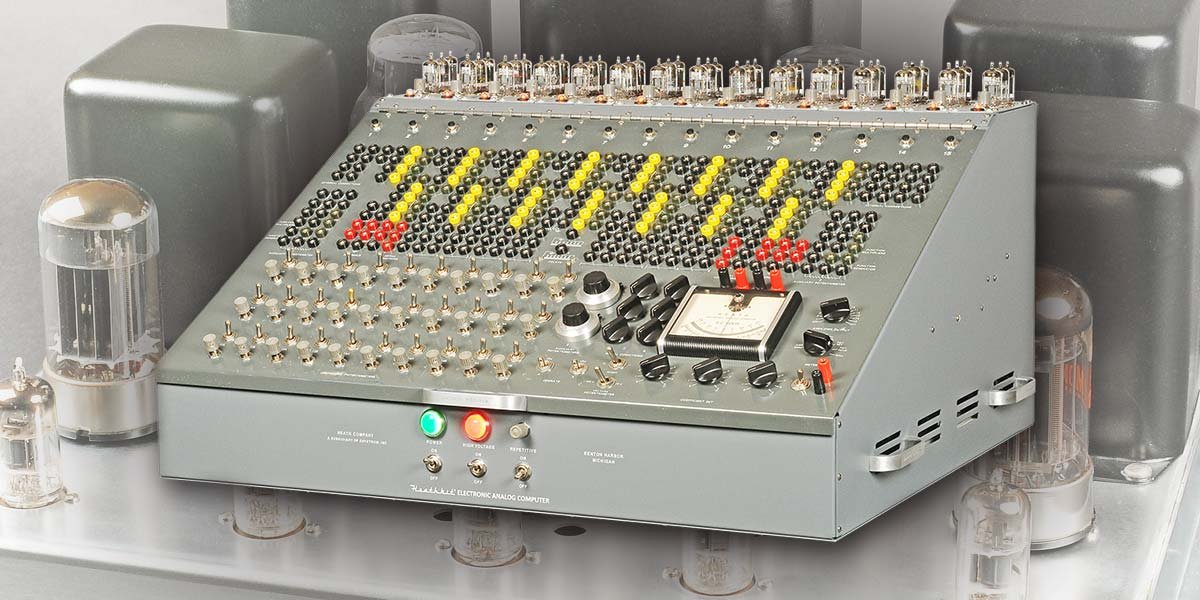 (reference — courtesy Nuts & Volts / David Goodsell)
7.6 Safety & Reversibility — Keeping the Restoration Original
7.6.1 The Case for Reversibility
An ES-400 in original, unmodified working condition is historically significant. Only 250–400 units were ever produced; fewer than a handful are known to be in working condition. The Goodsell restoration represents eight months of skilled labor and a significant parts investment. Every modification described in this volume is therefore designed to be:
- External — connected only to the 364 front-panel banana jacks and the 14 rear-panel connectors, never to internal wiring.
- Non-destructive — nothing drilled, soldered inside, or altered on the original PCBs, chassis panels, or front-panel silk-screening.
- Documented — all interface boards, attenuator networks, and bench-supply connections are described in a restoration log maintained alongside the machine (see §5.5).
Danger — Never drill new holes in the front panel or chassis for any purpose. The front-panel silk screening was produced at the factory and is irreplaceable; damage to it cannot be repaired to original condition. All external connections must use existing banana jacks and rear connectors only.
7.6.2 Modification Risk Matrix
Table 17 — 6.2 Modification Risk Matrix
| Modification | Reversibility | Risk to Original | Recommended? |
|---|---|---|---|
| Modern patch cords (banana, ≥300 V) | Fully reversible | None | Yes |
| 10× oscilloscope probe to output jacks | Fully reversible | None | Yes |
| Attenuator board (external, banana jacks) | Fully reversible | None | Yes |
| USB-DAQ connected via attenuator board | Fully reversible | None | Yes |
| External bench supply to B+ (via test leads) | Reversible | Low, if current-limited | With caution; label leads |
| Solid-state substitute ES-201 card | Reversible if original ES-201 retained | Medium (ES-201 connector wear) | Only with originals stored |
| New electrolytic capacitors (ES-2 internal) | Partially reversible (desoldering required) | Low | Standard restoration practice |
| New metal-film resistors (ES-201 PCB) | Partially reversible | Low | Standard restoration practice |
| Drilling chassis for new connectors | Irreversible | High | No |
| Repainting front panel | Irreversible | High | No |
| Rewiring internal harness | Partially reversible | Medium | Only if harness is already damaged |
7.6.3 Isolation Protocol Before Internal Access
Danger — The ES-400 contains lethal voltages on multiple rails: +250 V and −250 V on the amplifier bus, −450 V on the bias rail, ±100 V on the reference bus, and 110 VAC on the primary wiring. Before opening the chassis for any internal access:
- Switch the high-voltage switch to OFF and the main power switch to OFF.
- Unplug the AC line cord from the wall outlet.
- Wait at least 10 minutes for the ES-2’s filter capacitors (up to 70 µF at 350 V) to discharge through the bleeder resistors.
- Measure the +250 V rail with an insulated-probe DMM set to the 600 V DC range. Confirm voltage is below 10 V before touching any internal component.
- Measure the −450 V rail similarly. Confirm below −10 V.
- Work with one hand; keep the other hand away from the chassis and away from all bus bars.
The 14.5 A heater transformer can also store energy in its leakage inductance; verify the heater secondary reads below 1 VAC before touching tube heater leads.
7.6.4 ES-400 vs. EC-1 — Modernization Comparison
The ES-400 and EC-1 are sibling machines sharing the ES-201 op-amp design and the same banana-jack signal interface convention. Their modernization challenges differ in scale and detail:
Table 18 — The ES-400 and EC-1 are sibling machines sharing the ES-201 op-amp design and the same banana-jack signal interface convention. Their modernization challenges differ in scale and detail
| Dimension | ES-400 | Heathkit EC-1 |
|---|---|---|
| Signal rails | ±100 V | ±60 V |
| Plate supply | ±250 V (ES-2) | +300 V / −150 V (internal) |
| Bias rail | −450 V (ES-2) | None separately accessible |
| Op-amp modules | 15 × ES-201 | 9 × ES-201 |
| Tube count (active) | 45 (+ supply tubes) | 9 × 6U8 + misc |
| Divider for ±5 V ADC | 180 kΩ / 10 kΩ (ratio 1:19) | 110 kΩ / 10 kΩ (ratio 1:12) |
| Patch cord insulation required | ≥ 300 V | ≥ 100 V |
| Computing element plugs | Direct component lead insertion | Proprietary 2-pin phenolic plugs (discontinued) |
| Weight | 168 lbs (complete system) | ~35 lbs |
| Modules | 25 sub-assemblies | Integrated chassis |
The ES-400’s ±100 V signal range requires resistors and capacitors rated for a higher voltage than the EC-1. The two machines’ attenuator ratios are different: 19:1 for the ES-400 versus 12:1 for the EC-1. If adapting EC-1 interface circuits to the ES-400, all divider values must be recalculated. The EC-1’s proprietary plug problem does not exist on the ES-400 — a significant practical advantage.
7.6.5 Long-Term Storage
If the ES-400 is to be stored for more than six months:
- Remove tubes from all 15 ES-201 modules and power supply assemblies. Store each tube individually in a labeled box. Tube storage prevents heater filament sag from vibration and avoids cathode poisoning from extended storage at room air.
- Leave switches in their normal operating positions (or mid-travel) to avoid contact impression from prolonged compression.
- Store at 40–70°F, below 60% relative humidity. Newly reformed electrolytic capacitors (< 2 years since forming) will tolerate up to 18 months of unformed storage; beyond that, the forming procedure (§4.6) must be repeated before next power-up.
- Keep manuals and documentation inside the chassis or in an acid-free archival envelope physically attached to the machine. The Operational Manual is essential for any future operator.
- Photograph the front panel in its current patch state before storage if any problem setup is loaded. The patch constitutes the program; no photograph means the program is lost.
Tip — The Computer History Museum (Mountain View, CA) cataloged an ES-400 (catalog X799.86) in 1987. If the machine is ever to be donated or loaned to a museum, a complete restoration log — including all parts replaced, all calibration records, and all external interface boards — transfers with it and enables the institution to maintain the machine.
7.6.6 Documentation Standards
Every external interface built for the ES-400 should be documented with:
- A schematic or block diagram of the interface (at minimum a labeled block diagram).
- A BOM with supplier part numbers and purchase dates.
- A calibration record (at minimum: input voltage applied, output voltage measured, computed ratio) at five test points per §3.9.
- Photographs of the completed interface board and its connection to the ES-400 front panel.
- A reversibility statement: a single sentence explaining exactly how the interface is removed.
Table 19 — 6.6 Documentation Standards
| Date | Interface | Channel | Applied V | Measured Output V | Ratio | Technician |
|---|---|---|---|---|---|---|
| — | Attenuator Ch1 | ES-201 #1 output | +50.00 | +2.633 | 18.99 | — |
| — | Attenuator Ch1 | ES-201 #1 output | −50.00 | −2.627 | 19.03 | — |
| — | Attenuator Ch2 | ES-201 #2 output | +100.00 | +5.262 | 19.01 | — |
Ideal ratio is 19.000 (= 190 / 10). Values within ±1% of 19.0 indicate a well-matched divider. Values outside ±2% indicate a resistor out of tolerance or a defective solder joint.
7.7 Appendix A — Quick Reference: Safe External Connection Points
┌────────────────────────────────────────────────────────────────────────┐
│            ES-400 EXTERNAL INTERFACE QUICK-REFERENCE CARD              │
├───────────────────────┬────────────────────────────────────────────────┤
│ SIGNAL POINT          │ SAFE EXTERNAL CONNECTION METHOD                │
├───────────────────────┼────────────────────────────────────────────────┤
│ ES-201 #1–15 output   │ 10× scope probe direct (reads ±10 V for ±100 V │
│ (±100 V, red jacks)   │ actual); or attenuator board (180k/10k div +   │
│                       │ OPA2134 buffer → ADC input)                    │
├───────────────────────┼────────────────────────────────────────────────┤
│ Signal ground         │ Black banana post → tie to instrument GND      │
│ (0 V, black jacks)    │ ONCE. Do not create ground loops.              │
├───────────────────────┼────────────────────────────────────────────────┤
│ Coefficient pot wipers│ Connect via patch cord and series resistor to  │
│ (0 to ±100 V)         │ amplifier input jacks only. No direct external │
│                       │ instrument connection to wiper jacks.          │
├───────────────────────┼────────────────────────────────────────────────┤
│ ES-50 reference       │ Connect to amplifier input jack via patch cord.│
│ (±100 V, ref posts)   │ Do not connect external equipment to ref jacks.│
├───────────────────────┼────────────────────────────────────────────────┤
│ ES-100 IC supplies    │ Connect to amplifier IC input jack via patch   │
│ (±100 V floating)     │ cord only. Floating — isolated from chassis.   │
│                       │ Never ground these supplies externally.        │
├───────────────────────┼────────────────────────────────────────────────┤
│ ES-505 oscillator     │ Connect repetitive-mode output to scope TRIG   │
│ (0.6–6 Hz)            │ input as external trigger via 10× probe.       │
├───────────────────────┼────────────────────────────────────────────────┤
│ Oscilloscope output   │ CH1 ← X-axis variable; CH2 ← Y-axis variable  │
│ jacks (front panel)   │ Scope: DC coupling; XY mode; 10 V/div (×10);  │
│                       │ trigger: free-run or ES-505 external trigger   │
└───────────────────────┴────────────────────────────────────────────────┘

NEVER CONNECT TO: ES-2 internal bus bars, −450 V bias rail, heater
wiring, transformer taps, or any point inside the chassis while the
AC line cord is plugged in. The ES-2 alone weighs ~43 lbs and must
be fully discharged (10-minute wait, DMM verified) before internal access.
7.8 Appendix B — Troubleshooting External Interface Issues
Table 20 — Appendix B — Troubleshooting External Interface Issues
| Symptom | Probable Cause | Diagnosis | Remedy |
|---|---|---|---|
| ADC reads zero with ES-400 running | Attenuator output open | Measure R1/R2 junction with DMM (power off to interface) | Check solder joints; verify op-amp supply rails |
| ADC reads correct voltage but noisy (>50 mV RMS) | Ground loop between ES-400 and DAQ | Lift DAQ chassis ground at one end; use diff input mode | Use isolated USB-DAQ; add common-mode choke |
| Scope shows 60 Hz hum on all outputs | Heater coupling into amplifiers or scope probe loop | Reduce probe ground lead length; move scope away from ES-400 | Improve heater supply filtering; verify ES-2 heater ground |
| Attenuator clips at +5.3 V with ES-400 at +50 V | Buffer op-amp supply too low or wrong resistor value | Measure R1 in-circuit (power off); measure op-amp supply | Verify R1 = 180 kΩ ±1%; check Traco module output |
| Logged data shows step discontinuities | USB-DAQ sample rate insufficient for repetitive mode | Increase sample rate; check USB bus congestion | Increase to ≥500 S/s; use dedicated scope |
| External bench supply trips current limit on power-up | Unreformed electrolytic capacitors in ES-2 | Disconnect all ES-201 modules; apply ≤+50 V initial voltage | Reform caps per §4.6 procedure; proceed slowly |
| Attenuator shows −3 V offset with no ES-400 signal | Op-amp input bias or R2 resistor wrong | Short attenuator input to GND; observe offset voltage | Adjust offset trim on buffer; verify R2 = 10 kΩ |
| ES-201 substitute card oscillates at high frequency | Insufficient compensation on solid-state substitute | Observe with scope at 1 MHz bandwidth | Add 600 Hz single-pole rolloff (RC = 265 µs) to compensation pin |
| NE-51 lamps illuminate on multiple ES-201 modules | Amplifiers saturated; likely IC supply voltage off | Check ES-50 ±100 V rails; check ES-100 initial condition values | Verify ES-50 output; rebalance all 15 ES-201 balance pots |
Volume 7 of the Heathkit ES-400 Deep Dive Reference Series. See Vol 2 for ES-201 amplifier circuit theory and ES-2 power-supply architecture; Vol 3 for the patch panel and computing elements; Vol 4 for restoration procedure; Vol 5 for programming methodology and scaling; Vol 6 for worked demonstration programs including the bouncing-ball setup. The sibling Heathkit EC-1 deep dive Vol 7 covers the equivalent modernization topics for the smaller nine-amplifier machine and is recommended as a parallel reference.
Comments (0)